2026-03-13
Where to Buy Vitamin D3 in Cardiff
Why vitamin D3 matters in the UK, how much to take, the difference between D3 and D2, why K2 is often paired with it, and what we stock at Beanfreaks.
Vitamin D deficiency is not a fringe concern in the UK. The NHS estimates that around one in five people in this country have low vitamin D levels. In Wales, with its overcast winters and the latitude working against us, the number is likely higher. The Government’s own advice is that everyone should consider supplementing between October and March.
March is when most people stop thinking about it. That is worth reconsidering.
The sunshine problem
Your body produces vitamin D when UV-B radiation from sunlight hits your skin. The problem is that the sun in the UK is not strong enough to trigger this process for most of the year. From October through to March, the UV-B index at our latitude is too low regardless of how much time you spend outside. You can sit in full winter sun in Cardiff for hours and produce essentially no vitamin D.
From April onwards the sun gets strong enough, but the level of skin exposure most people actually get during a working week is still often insufficient to maintain good levels through summer, let alone build up reserves for the following winter.
The practical upshot: most people in the UK benefit from supplementing vitamin D year-round, not just in winter.
D3 versus D2
There are two supplemental forms of vitamin D: D2 (ergocalciferol) and D3 (cholecalciferol).
D3 is the form your body produces naturally from sunlight. When you supplement with D3, your body processes it exactly as it would sunshine-derived vitamin D. D3 is significantly more effective than D2 at raising and maintaining serum vitamin D levels. Studies consistently show D3 produces higher and more sustained blood levels for the same dose.
D2 is cheaper to produce and was historically the standard supplement form. It is still common in fortified foods. If you are buying a specific supplement to address or prevent deficiency, D3 is the form worth looking for.
Why you must take K2 with D3
Vitamin D3 increases calcium absorption from food and supplements. This is largely the point: adequate vitamin D is needed for calcium to reach bones at all. The problem is that increasing calcium absorption without proper routing leads to calcium depositing in soft tissue and arteries rather than where it should go — a process linked to arterial stiffness and cardiovascular risk.
Vitamin K2 (specifically the MK-7 form) activates two critical proteins: osteocalcin, which binds calcium into bone, and matrix Gla-protein, which actively removes calcium from arteries and soft tissue. Without sufficient K2, the extra calcium D3 puts into circulation has nowhere to go except where you do not want it.
This is not a nice-to-have pairing. If you are taking D3 at any meaningful dose, K2 is essential. D3+K2 combination products exist precisely because taking D3 alone at higher doses without K2 is potentially counterproductive. Always look for K2 as MK-7 rather than MK-4, as MK-7 has a much longer half-life in the body and is the form with the strongest evidence.
How much to take
The NHS recommends 400 IU (10 micrograms) daily for the general population. This is widely considered a bare minimum to prevent outright deficiency, not a target for optimal health.
There is a well-documented problem with this figure. In 2014, statisticians identified a significant calculation error in the original Institute of Medicine data used to set the RDA. The IOM confused individual variation with group averages, meaning the dose calculated to achieve adequate levels in 97.5% of individuals was massively understated. When the data are analysed correctly, 600 IU achieves only around 27 nmol/L in 97.5% of people — well below the 50 nmol/L threshold considered sufficient. The corrected figure to reliably achieve sufficiency across a population is closer to 8,895 IU per day. This error has been known in the research community for over a decade and remains uncorrected in official guidelines.
In practice, most people supplementing for genuine sufficiency take between 2,000 and 5,000 IU daily. People with darker skin tones, those who spend most of their time indoors, and those who are already deficient typically benefit from the higher end of that range. A blood test (serum 25(OH)D) is the reliable way to know where you actually stand.
At these doses, vitamin D3 is safe for most people. Toxicity is a concern only at very high doses — well above 10,000 IU — sustained over long periods.
Spray versus capsule
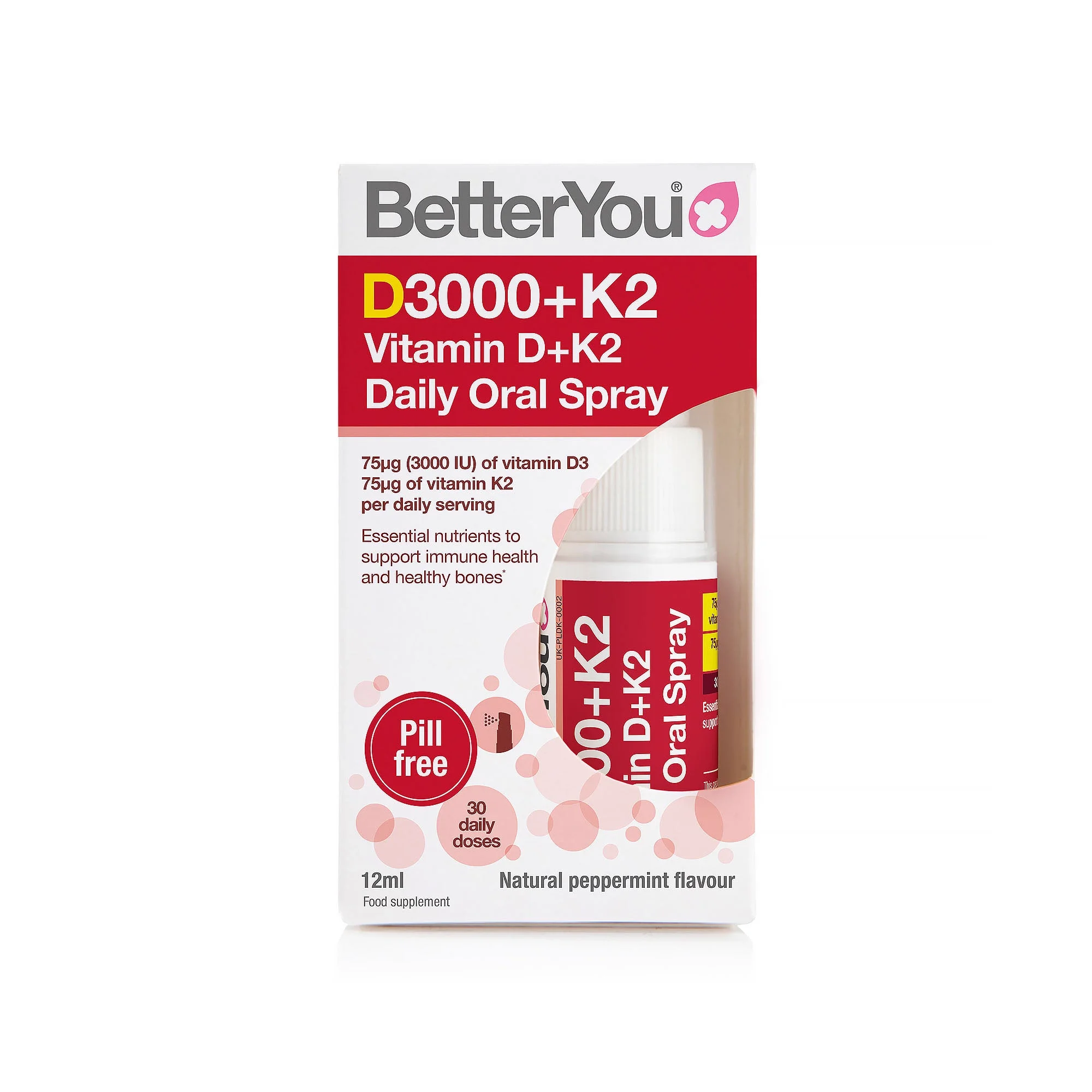
The spray format, popularised by BetterYou, delivers vitamin D directly through the oral mucosa (the lining of the mouth), bypassing the digestive system. This is particularly useful for people with gut absorption issues, including IBS, Crohn’s disease, or anyone who has had bowel surgery.
For most people without absorption issues, well-formulated softgels in an oil base (vitamin D is fat-soluble and absorbs better taken with fat) are equally effective and often better value per dose.
Vegan vitamin D3
Standard vitamin D3 supplements are derived from lanolin, a wax from sheep’s wool. This makes them unsuitable for vegans.
Vegan D3 is derived from lichen, a naturally occurring source of D3 in the plant kingdom. It is just as effective as lanolin-derived D3. If you are following a plant-based diet and supplementing vitamin D, check the label: it should specifically say vegan D3 or lichen-derived D3, not just vitamin D3.
What we stock
We carry BetterYou at all three Beanfreaks stores. Their D-Lux range includes the D+K2 combination spray and a range of doses for different needs, including a vegan-certified option.
We also carry Solgar vitamin D3 softgels, a well-established option for those who prefer a traditional capsule format.
Come in and ask if you are not sure which product or dose is right for you. Vitamin D is one of the most common supplements people ask us about and we are happy to talk through the options.
- Roath: 95 Albany Road, CF24 3LP
- Canton: 124 Cowbridge Road East, CF11 9DX
- Royal Arcade: 8 Royal Arcade, Morgan Quarter, CF10 1AE
Get in touch to check stock at your nearest store.