2026-01-30
What's the Difference Between Raw Honey and Regular Honey?
Raw honey and supermarket honey look similar but are very different products. Here is what happens during processing and why it matters.
Walk past the honey shelf in a supermarket and it all looks much the same: clear, golden, pourable, identical from jar to jar. Raw honey looks different. It is cloudier, thicker, and often crystallised. That difference is not a quality problem — it is the point.
Here is what separates them.
What happens to regular honey
Most honey sold in supermarkets goes through two processes before it reaches the shelf: pasteurisation and filtration.
Pasteurisation means heating the honey to around 70°C or above. This kills any wild yeasts that could cause fermentation, makes the honey more liquid and easier to bottle, and extends shelf life. It also destroys most of the natural enzymes present in raw honey, reduces antioxidant content, and removes or degrades the pollen.
Filtration removes the remaining particles: pollen, beeswax fragments, air bubbles, and propolis. The result is a clear, smooth, uniform product that looks clean and stays liquid for longer on the shelf.
Neither process is done to improve the honey nutritionally. Both are done for commercial reasons: appearance, consistency, and shelf stability.
What raw honey is
Raw honey is honey as it comes from the hive, with minimal processing. It is not heated beyond hive temperature, and it is only coarsely strained rather than finely filtered. This preserves:
Enzymes: Raw honey contains naturally occurring enzymes including diastase and glucose oxidase. These are largely destroyed by pasteurisation.
Pollen: Raw honey retains pollen from the flowers the bees visited. This is how you can trace where honey came from and is the basis for why local raw honey is used by people managing hay fever.
Propolis: A natural antimicrobial substance produced by bees, present in raw honey and largely absent from processed honey.
Antioxidants: Raw honey has significantly higher antioxidant content than pasteurised honey.
Flavour: The taste reflects the flowers, the season, and the landscape. Two raw honeys from different locations will taste noticeably different. Pasteurised honey tends to taste the same regardless of origin.
Why raw honey crystallises
Crystallisation is one of the most misunderstood things about honey. A lot of people assume it means the honey has gone off or is lower quality. The opposite is true.
Honey is a supersaturated sugar solution. Over time, the glucose naturally separates from the water and forms crystals. Raw honey crystallises faster than processed honey because it retains the pollen and other particles that act as nuclei for crystal formation.
Crystallised honey has not changed nutritionally. To return it to liquid form, place the jar in warm water (not hot). Never microwave it or heat it above 40°C — that would start to degrade the enzymes you are trying to preserve.
Set honey (sold deliberately in a thick, spreadable form) is simply honey that has been allowed or encouraged to crystallise uniformly.
How to tell if honey is raw
Look at the label. Raw honey should say “raw” and ideally “unpasteurised.” It should not say “clear” or “runny” as a selling point — those are signs of processing.
The appearance helps too. Raw honey is often cloudy or opaque rather than crystal clear, and it may have visible particles or a slightly granular texture. If a honey is perfectly clear and has stayed perfectly liquid for months on the shelf, it has almost certainly been pasteurised and filtered.
Does it matter which you use?
For cooking and baking at high heat: not particularly. Heat will degrade the enzymes regardless of whether the honey started raw.
For eating directly, stirring into warm drinks, or using for its natural properties: raw honey is meaningfully different and worth paying more for.
What we stock
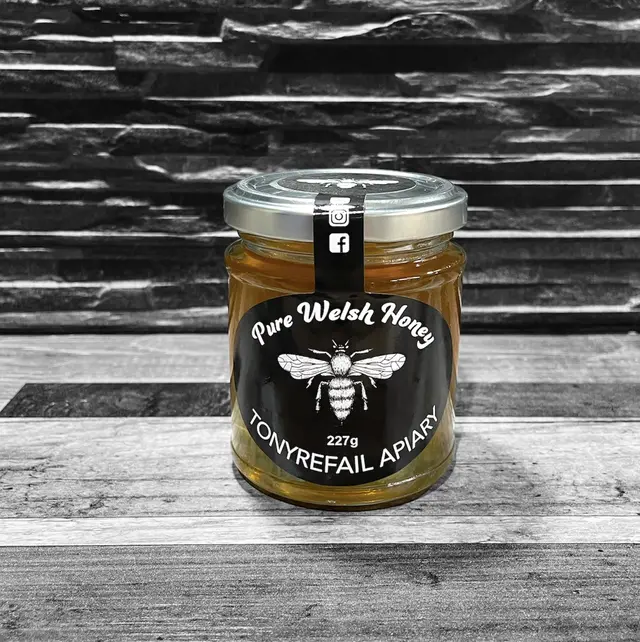
We stock raw Welsh honey from Tonyrefail Apiary, made by a family of beekeepers in the Rhondda Cynon Taf from local wildflowers. It is unpasteurised, minimally processed, and as close to the hive as honey gets.
Find it at all three Beanfreaks stores in Cardiff:
- Roath: 95 Albany Road, CF24 3LP
- Canton: 124 Cowbridge Road East, CF11 9DX
- Royal Arcade: 8 Royal Arcade, Morgan Quarter, CF10 1AE
Get in touch to check stock before visiting.